|
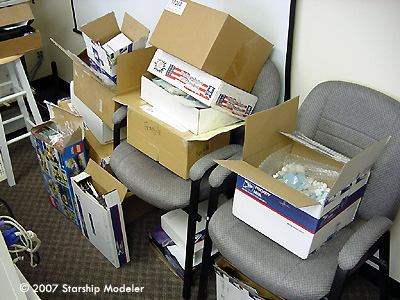
By Matt Jacobson - images & text © 2007 Editor's Note: What could you build given 2 pounds of parts and a deadline? Back in 2004, a challenge was issued on the Starship Modeler Discussion Forums to answer just that question. Participants scoured their strategic styrene reserves for likely parts, then sent them in to SSM, where they were randomly boxed up and sent back out again. None of the participants knew what they would get. The results .... well, see for yourself. The full record of events is still online on the Discussion Forums (though some of the individual links have undoubtedly decayed since then). |
![[please click to enbiggen]](mj_box_qdsfinattack.jpg) |
|
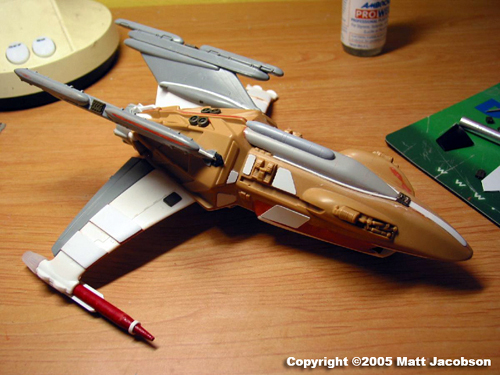
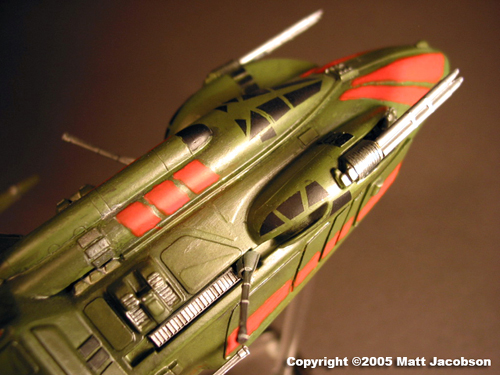
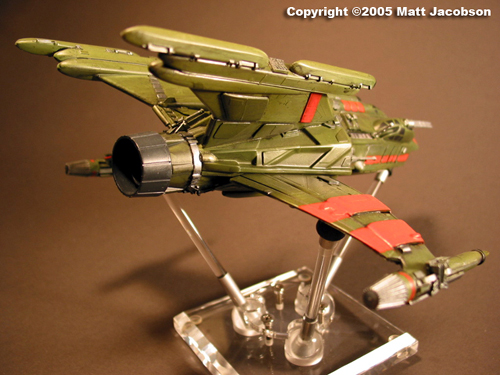
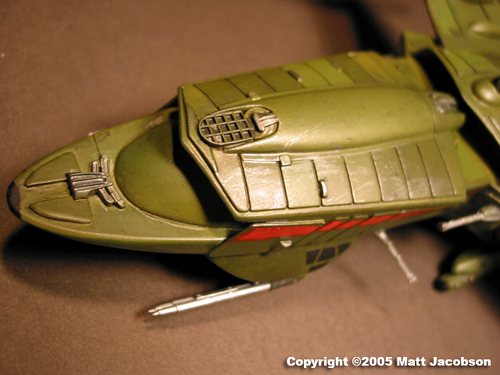
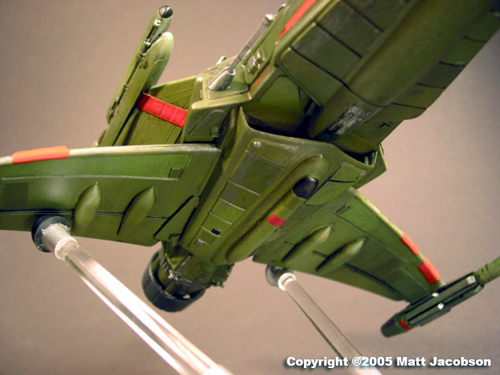
Part I: Design Backstory The taj Dogh toQ biQ'a' Hegh (literally, "metal stupid sea bird (of or causing) death"; Federation code-name "Steel Puffin") is an obsolete Klingon fission-powered planetary assault craft, unique in its lack of conventional landing gear. The ship was intended for primary planetary assault. As part of the first attacks against an enemy world, the "Steel Puffin" would drop into atmosphere from an orbital carrier, strafe and bomb strategic targets while spraying radioactive smog as exhaust, then return to the carrier after successful completion of its mission. This ship dates from the last days of the First Interstellar Klingon Empire. Variants of the design remained in active service for almost two hundred years, before lack of parts and surviving airframes made continuing empire-wide operation of the class impossible. Some Klingon allies continued to fly surplus models of the ship until the late 2100's… or at least, until they realized exactly why they had been (in some cases) given the "Steel Puffin". |
|
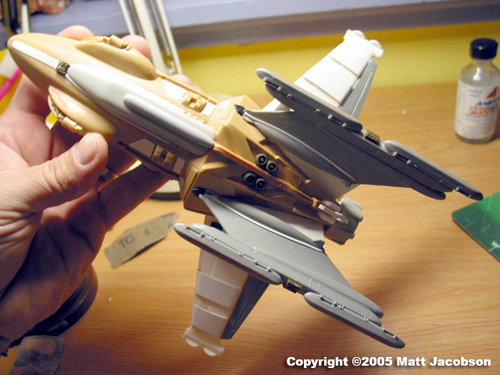
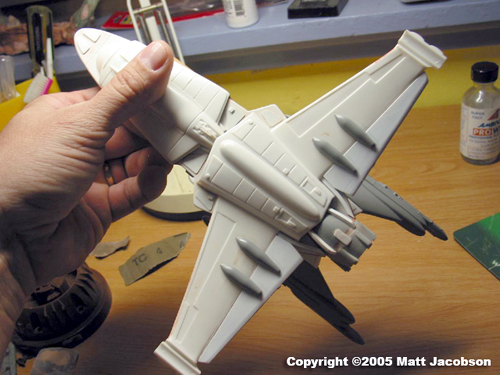
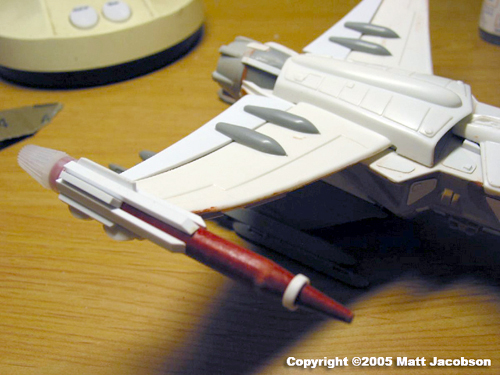
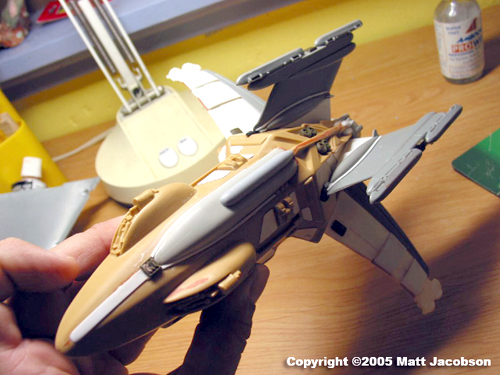
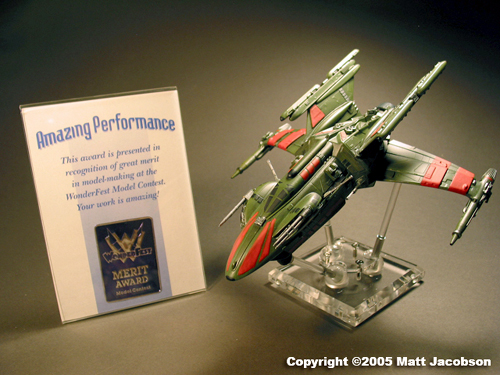
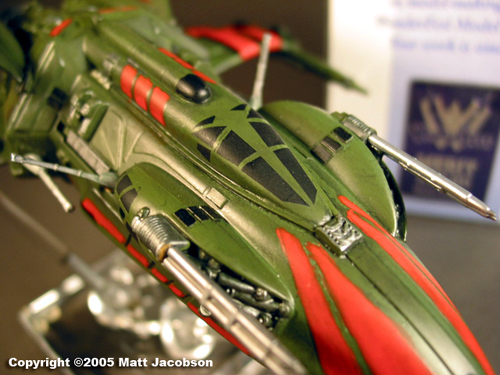
Image: Parts I decided to use Image: For another project .... Image: Basic shapes Image: Other side Image: Underneath Image: Wing tip gunpod Image: Built-up pods Image: Underneath Image: Head-on (well, nose-on, anyway) Image: Flying by Image: Front/left Image: Underneath Image: Port side Image: Top/left view Image: Right/front Image: Turrets Image: Right/rear Image: Bottom/front Image: Bottom/rear Image: With award Image: Cockpit canopy |
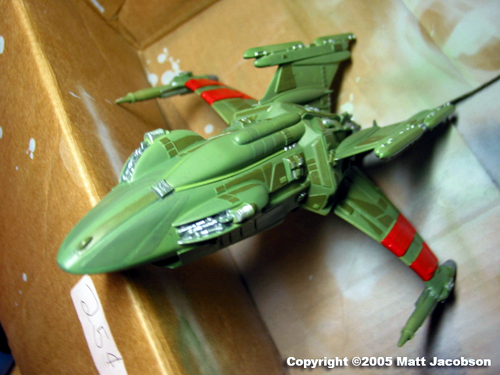
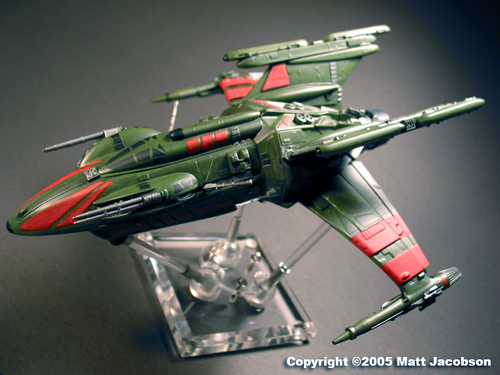
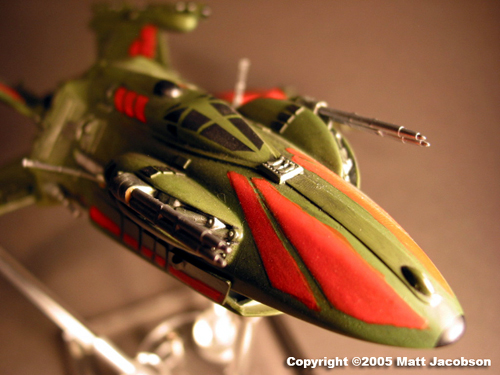
The ship’s awkward design is due as much to Klingon societal, social, and political needs, as to the idiosyncrasies of Klingon design. Bluntly put, when used correctly this ship was designed and built to be almost as dangerous to its crews as to the enemy they fought. It was not unusual for the more powerful Houses of Q'onoS to rid themselves of troublesome heirs by assigning them the “honor” of piloting a “Steel Puffin”. The lack of functional landing gear, ostensibly to reduce weight, was actually designed to keep Klingon pilots from claiming a piece of land on a soon-to-be-conquered world for themselves (by right of personal victory). If the vehicle was attacked and damaged so that it could no longer function, the pilots were encouraged to find a large strategic enemy object, and ram it with as high a speed as could be attained, singing appropriate battle songs right up to impact. (External amplified speakers under the nose allowed the enemy to hear these songs, and respond with appropriate terror.) A crew that somehow, despite all odds, managed to soft-land a “Steel Puffin” would usually find that their flight software was programmed to immediately SCRAM their fission pile, making it impossible to exit their ship in a timely fashion before it melted into a glowing puddle of slag. Offensive armaments for the class included two wingtip-mounted Class VIII disruptors and two forward-facing Class VI dual disruptors (with frequency-tuning capability to penetrate shields) mounted on either side of the cockpit. Up to twelve “Ocelot”-class cruise missiles could be mounted above the ECM pods on its vertical stabilizers, each capable of carrying various warheads and EW payloads. Defensive armaments included two Class IV disruptors, operated from gunner’s turrets set to either side of the main cockpit, and two Class IV automated disruptor turrets mounted on the forward reactor bulkhead. (This defensive armament, rare in a Klingon assault ship, served two separate purposes: the manned turrets served to placate crews as to their chances for survival, and allowed the Empire to crew ships with three “examples to others” at once.) While seemingly well-armed for both assault and defensive roles, the “Steel Puffin” was subject to high crew and ship attrition rates. This was the result of its slower atmospheric speed and its larger radar/infrared signature (in comparison to other front-line Klingon ships of the period), and the relative complexity of re-docking after completion of a successful mission. On average, fewer than forty percent of “Steel Puffins” successfully returned their crews to their base carriers. Of these, some additional crews were lost because the returning pilot could not master the intricate maneuvers required to dock the ship. Rather than risk the dishonor of asking for help, pilots simply chose to run the risk of suffocation in making attempt after attempt to dock. More than a few crews died in this process. There are unsubstantiated rumors that one quasi-legendary Klingon pilot, irritated at missing the docking ring on his fifth try, simply rammed the carrier and stepped out into a breached corridor. He was summarily sentenced to a slow and painful death, as a warning to others who might be tempted to show such initiative. (As an aside, the “Dogh toQ biQ'a' Hegh”- the Klingon avian creature for which this class is named- is roughly analogous to a terrestrial duck, but carnivorous, with a strong, sharp beak, talons, and a taste for eyes. To capture these creatures, one Klingon hunter stands as bait; the other, in hiding until the last moment, swings a handled wooden plank to impale the beak of the avian creature in the wood surface. It is considered bad form to either hit the “bait” with the plank, or to be late in one’s plank swing. The “Dogh toQ biQ'a' Hegh” is customarily cooked and served on the plank, and is said to taste much like chicken.) -from Jane’s Guide to Klingon Ships, 2nd Edition While waiting for the Kizmar Shuttle on the repatriated world Flammarion Theta, a “must see” is the one remaining Klingon “Steel Puffin” (outside of Q'onoS) in the Alpha Quadrant. It can be seen in Freedom Park, where it stands as a war memorial to the Flammarion Resistance. Its rusting, dented hulk is in some disrepair, balanced precariously on a granite pedestal. Still, it gives some sense of the danger the Klingon Empire once posed in this sector... especially since its fission pile is still quite active. Federation tourists are encouraged to stand well behind the holographic warning markers. Have a cool, refreshing fizz tea at one of the many bistros surrounding Freedom Park- but don’t stand downwind, and don't forget to check your dosimeters! Qapla' ! - from Fromminger’s Guide to the Outer Rim, 3rd edition. Part II: Building the Model “Limits have a great deal to do with style. Where there are no limits, there is no style.” |
|
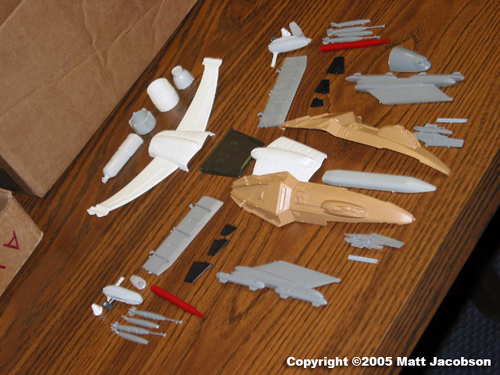
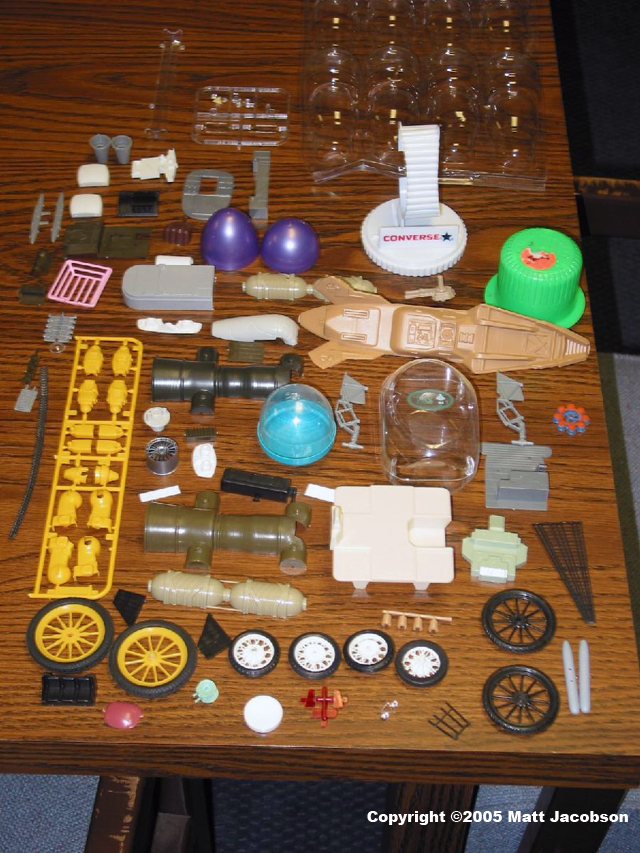
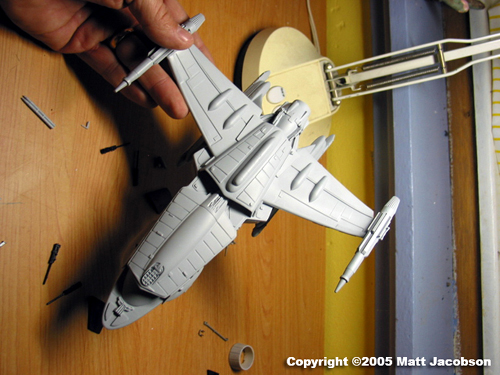
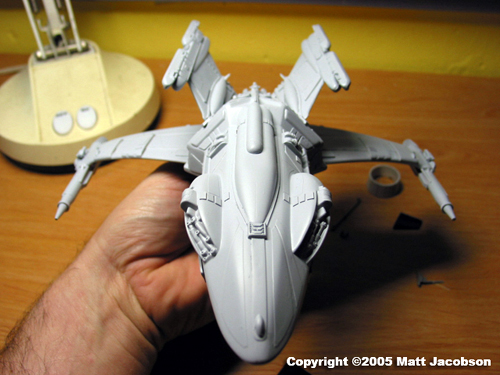
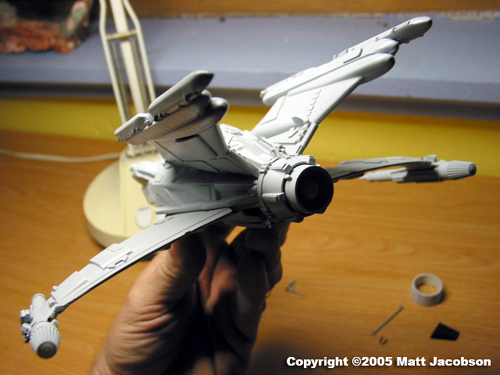
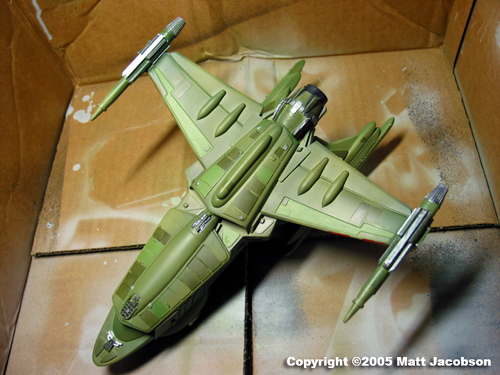
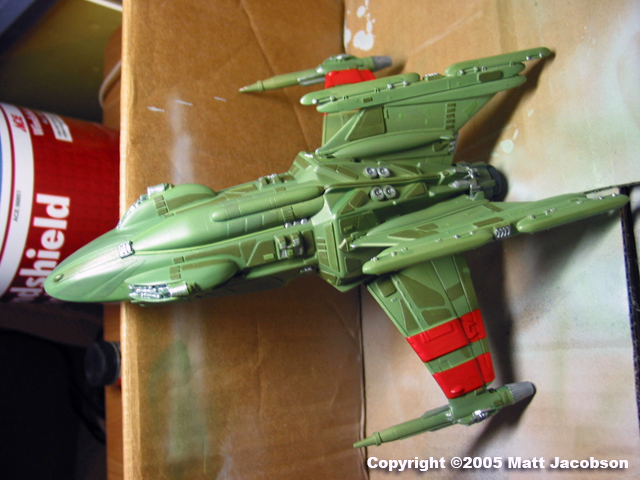
Participating in a challenge like this one seemed like a natural choice for me, as I have never liked building "stock" kits. I am always "bashing" kits into other designs, or creating new designs of my own that better fit my own ideas of what a kit or ship should really look like. So, after making the commitment to join the "Box Of Stuff" challenge, I fired off my box of donor parts to Chicago, and settled in to wait. I looked forward to getting my "Box Of Stuff" with a weird combination of barely-suppressed glee and utter dread. It was the idea of sitting in anticipation of a bunch of parts I've never seen before, coming to me without any preconceived ideas about what I'm going to do with them. It's like when you're a kid, and it's Christmas morning, and there's a box underneath the tree that doesn't match the profiles of anything you've asked for or are expecting. Add to that the idea that this challenge was a commitment to FINISH something... Unlike the last few contests (unbroken record, since 1998), I feel compelled to actually put something together by the deadline, even if it was so I didn't let down my anonymous donors. So, I open my box, and spread out the parts… Hmmmm… As I found out later, Vince Hoffman supplied (amongst other things) a bunch of wagon wheels and bomb racks, Captain Bob provided (again, amongst other things) a whole Reliant rollbar and assorted parts, B-52 pylons, hexagonal sprues, PVC, lil' bits and ...THE SPOON, Yeti-Man provided an egg full of tiny bits, and some unknown genius supplied most of a Kazon Torpedo and the head and torso of a speeder bike pilot. After I opened the boxes and sorted out all the pieces, I started to put parts together in interesting combinations. Immediately, two of the halves of the Kazon Torpedo and the Reliant rollbar seemed to work together as a fighter of some sort. (I think it's just kind of fun to see what you can make out of a Kazon Torpedo... if you're not making a Kazon Torpedo, that is.) The Reliant rollbar was especially effective as a wing section, with the other side of the rollbar being especially effective placed "nose to nose" under the two halves of the Kazon Torpedo as an intake of some sort. After coming up with this basic plan, I felt that the design needed some control surfaces added to the wings and fuselage, and guns of some sort to the wingtips. Moreover, to match the armor on the rollbar, I would probably end up plating a goodly portion of the rest of the surface. (Luckily, I did get some styrene sheet and strip, and some thin clear vac plastic that was perfect for very thin curved plating…) Several other pieces seemed to fit naturally into the design- a conformal ECM pod with half a torpedo on top made a good canopy (which meant that I'd have to create the windows with black decals- not a problem, as I didn't have too many cockpit pieces.) A couple of 1/72 B-52 bomb pods were my next choices (hmmm, let's see- how about calling them V-tail stabilizers with stand-off cruise missiles?) Even a couple of wooden tees and pen caps worked their way into the design (as wingtip guns, with strip styrene and tank bogie "greeblies".) Of course, the original taped-together design included other parts that never worked their way into the final design, including two B-52 flaps, a Jeep hood, and a stack of Sea Shadow pontoon stabilizers. (These kit parts would eventually end up back in the "Box Of Stuff" box, as potential parts for the next model…) Eventually, the ship designation I came up with would be that she would be a "dropfighter"- a ship designed to drop from orbit for a planetary aerial/surface attack run, then return to her orbital mothership. Such a design would not require landing gear- a good choice, as I was not finding appropriate parts in the pieces I had received. (Eventually, this lack of landing gear became an important part of the back-story created around this ship.) At this time, as construction was beginning, I still couldn't make up my mind as to whether or not she was a human or alien design. A part of me was thinking about all of the plating, and thought that she'd be a good Klingon fighter- a "War Sparrow", or "Death Pigeon", or some such. (Eventually, it was Dr. Yo who came up with the name "Steel Puffin". Ironically, he intended it as a joke, but with that big clownish nose and squat body, what else could it be?) Assembly went exceptionally smoothly. The razor saw came out early, and stayed in use fairly regularly, right up to the bitter end. Lots of superglue and zap, and red Bondo filler along the sides (this kit predates my conversion to Aves.) To conceal the outline of the Reliant roll-bar wings, I cut the B-52 tail I received into flaps. More B-52 bomb halves added underwing detail. When I finished the construction of the "Steel Puffin", I jumped right into laying down the primer coat. (I LOVE how a good primer coat pulls all of the elements of a ship together, and this was no exception.) This was the first project where I had used an airbrush and acrylic paints from the start. Kylwell suggested painting her up as a Klingon ship, especially appropriate given her overcompensating armament. That's finally what I went with- olive green and dark green with red accents. So, after I finished the basic paintjob and took pix… well, she just sat there, from September 2004 to April of 2005. Why? I underwent some major surgery, which played havoc with my schedule. Add to that the fact that I was working on a big project, and it was perhaps obvious that the "Steel Puffin" was somewhat low on the "to do" list. In April 2005, after school got out in the spring, I realized that I was going to have to get this ship finished for display at Wonderfest. I finally finished painting and weathering the "Steel Puffin" during the week before Wonderfest. In retrospect, some of the choices I made were not the best- the wash was a little too heavy and dark, and the red accents were brushed on instead of airbrushed. I also learned that brushing bright red over dark green is not advisable- an intermediate coat of white would have made my life easier, and required fewer coats. Knowing what I know now, I would probably do the windows differently, as well- maybe masking them off and dusting them with Future for a more glass-like shine, or simply masking them from the Dullcote. I was still building and painting detail parts the morning I was flying out. I forgot to add the Class IV disruptor turrets (which started out as the tips of some bombs with really loooooong fuses) until I was in the shower. I jumped out, built and painted them in 30 minutes- only pausing briefly about halfway through to get dressed, after I realized that working on a model just out of the shower, while dripping wet and practically naked, is not a good idea if you're working with X-Acto blades and superglue. I tossed my two models in a padded camera case, and drove off for the airport. On the way, I stopped at the local Hobby Lobby and bought the cool Lucite articulated stand. (It was on sale at 50% off- an auspicious sign.) When I got to Louisville, the ship had suffered some slight damage. Thank goodness my friends who had driven in had some tools and supplies I glued on the final bits in Kylwell's room. Put her on display the next morning, and then it was all over but the voting. I still can't believe that I won an Award of Merit at WF '05, especially since this was the first time I'd had anything in competition. Parting Shots I'm REALLY looking forward to the next "Box Of Stuff" competition. It's also made me look at all of my scrap parts a little differently. The stuff I picked up at the junk table at WF '05 has already turned into the beginnings of three kits! It's funny, but I hadn't realized just how much my modeling abilities have improved in the last few years, since I've been picking up tips and tricks from the folks here at SSM. I ended up using almost every trick in the book, building and painting this model. And I really need to get to work on the Mars Rollagon. Heck, I've even figured out how to use the Speeder Trooper- or at least his boots… A Martian "Ozymandias", anyone? |

This page copyright © 2007 Starship Modeler™. First posted on 18 June 2007.
![[Please click to enlarge]](mj_box_abosall.jpg)
![[Please click to enlarge]](mj_box_cbostape.jpg)
![[Please click to enlarge]](mj_box_idsprimerfront.jpg)
![[Please click to enlarge]](mj_box_mdspainttopds.jpg)
![[Please click to enlarge]](mj_box_rdsfinwhol.jpg)